Frank Morris — From Deportation to Fife Flyers Legend
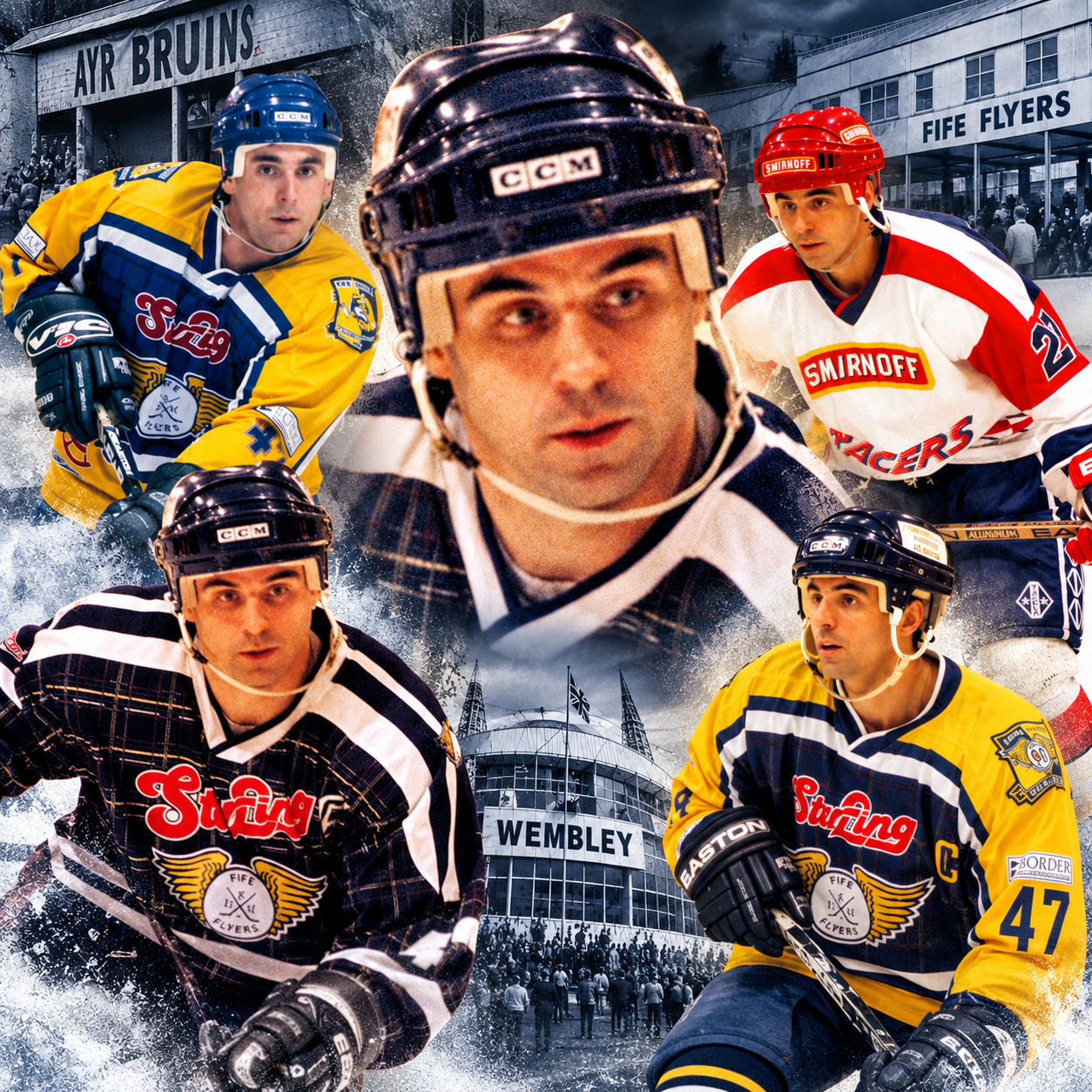
From being deported before he had even played a game, to Wembley, championships, 91 goals in a season and having his No. 47 retired by the Fife Flyers — Frank Morris certainly didn't have an ordinary British ice hockey career.
When Frank Morris first attempted to enter Britain in 1987, his new career in British ice hockey very nearly ended before it had begun.
He arrived at Heathrow Airport carrying three enormous hockey bags, four dozen sticks and an open-ended airline ticket — while attempting to convince British immigration that he was simply coming over to visit a friend.
It didn't go particularly well.
He was deported.
What followed was a British hockey adventure that would eventually stretch from 1987 through to the 2004–05 season, taking Morris from Ayr to Fife, Murrayfield and Trafford before bringing him back to Kirkcaldy.
There were Wembley appearances, championships, financial crises, international hockey, coaching and some extraordinary scoring seasons along the way.
And there were stories.
Lots of stories.
Including one involving Grant Slater and a collection of hockey sticks that remains one of the funniest tales ever told on the Old Time Hockey UK Podcast.
From Winnipeg to British Ice Hockey
Morris had already built an impressive hockey résumé before Britain entered the picture.
After playing university hockey with the Concordia Stingers, he attended the Winnipeg Jets training camp in 1987, signed a contract and went to Moncton in the American Hockey League.
But instead of continuing down the North American professional route, Morris decided to try something completely different.
Europe beckoned.
And more specifically, Ayr in Scotland.
There was just one problem.
Nobody appeared to have properly explained to British immigration why he was coming.
Morris recalled being advised that when he arrived at Heathrow he should simply tell immigration officials he was visiting a friend.
Unfortunately, he didn't exactly look like an ordinary tourist.
He had an open-ended ticket.
He had three huge hockey bags.
And he had around four dozen hockey sticks.
Eventually, the immigration officer asked him what he was really doing in Britain.
Morris admitted that he had come to play ice hockey.
That was that.
He was put back on a plane, escorted by police and returned to Montreal.
It took around a month for the visa situation to be sorted out before he could return — this time legally — and finally begin his British hockey career.
Years later there would be a wonderfully ironic sequel.
Having eventually become a British citizen, Morris returned to Britain following his mother's funeral in Canada using his Canadian passport because his British passport had expired.
Once again, he found himself arguing his case with immigration officials.
After everything that had happened since 1987, Morris joked that being deported for a second time would at least have rounded the story off nicely.
“I’m Going Home”
Getting through immigration was only the beginning.
Morris was collected by Ayr's Kevin Fennessy, complete with a bale of hay in the car, and taken to see his new hockey surroundings.
Then he saw Lime Kiln Road.
More specifically, he saw the tiny practice pad.
Coming from North American hockey, Morris wondered exactly what he had let himself in for.
His initial reaction was simple:
He wanted to go home.
Fortunately for Ayr supporters, he didn't.
Once Morris settled, the goals started coming — and they kept coming.
His first season with Ayr in 1987–88 produced 37 goals and 74 points in just 25 league games.
But that was merely the warm-up.
The following season Morris exploded offensively, recording 68 goals and 126 points in 35 games.
This was no short-lived import adventure.
Frank Morris was becoming one of the major personalities and offensive forces of British hockey.
Ayr, Wembley and One That Got Away
The 1988–89 season took Morris and Ayr all the way to Wembley.
Standing between them and the final were the league champions, Durham Wasps.
Ayr produced a memorable performance, defeating Durham 12–6 in the semi-final to book their place in the Wembley final against Nottingham Panthers.
For Morris, playing at Wembley was something special.
British hockey's annual pilgrimage to Wembley Arena had an atmosphere all of its own: supporters from across the country, rival shirts mixing in the same building and a weekend that became a reunion for the sport.
The final itself remained close for much of the game.
The teams were tied 1–1 after the opening period and 3–3 after two before Nottingham pulled away in the third to win 6–3.
Morris recalled the loss of Danny Shea through injury as a major moment in the game.
For Ayr, it was a case of what might have been.
For Morris, however, Wembley became another part of a British hockey experience that he would never forget.
When British Hockey Wasn't Quite So Glamorous
Of course, the Heineken League wasn't only packed rinks, big scoring nights and Wembley weekends.
There was another side to British hockey.
Money problems.
And Morris experienced those too.
By 1990–91, Ayr were in serious financial trouble.
Home games were moved away from Ayr, players weren't being paid and supporters were understandably angry.
Morris even recalls hearing that an effigy of him may have been burned by disgruntled supporters.
Yet he stayed.
The club battled on after the financial collapse, money was raised and Ayr somehow came within touching distance of another Wembley appearance.
They were eventually denied by Peterborough after a dramatic late comeback.
It was typical of the era.
Chaos off the ice.
Drama on it.
And somehow everybody turned up the following week and did it all again.
Fife Flyers — And a Remarkable 178-Point Season
In 1991 Morris moved to the Fife Flyers.
It would prove to be the defining relationship of his British hockey career.
Fife had been relegated and the objective was clear: get the Flyers back up.
The season wasn't straightforward. Players came and went, youngsters were brought into the team and Morris found himself surrounded by a changing cast.
But what happened statistically was extraordinary.
In 36 regular-season games during 1991–92, Frank Morris scored:
91 goals.
He added 87 assists.
That gave him an astonishing:
178 points in 36 games.
That's an average of almost five points per game.
Even by the spectacular scoring standards of British hockey in that period, those are extraordinary numbers.
The promotion battle eventually came down to a group involving Fife, Ayr, Romford and Telford.
Against his former club Ayr, Morris remembers scoring what may have been the crucial sixth Fife goal in an 8–6 defeat — enough for the Flyers to progress 14–13 on aggregate after their 8–5 victory in Kirkcaldy.
Fife had achieved their objective.
For Morris, however, the relationship with the Flyers was only beginning.
Murrayfield and Another Taste of Success
Morris subsequently moved to the Murrayfield Racers.
The Edinburgh club had assembled a formidable group containing the likes of Tony Hand, Paul Hand, Paul Pentland, Moray Hanson, Mike Ware, Chris Palmer and Richard Laplante.
Morris had actually agreed to join Murrayfield before Rocky Saganuk took charge, but it developed into another memorable chapter.
The Racers won the Benson & Hedges Cup, giving Morris another major honour in British hockey.
Unfortunately, there was a familiar problem lurking in the background.
Money.
Once again Morris found himself at a club facing serious financial difficulties.
The players eventually agreed to play the final month without being paid.
Then came the almost surreal situation of Murrayfield being unable to use their own rink, forcing them to play their “home” playoff games at Fife.
And who eliminated them?
The Fife Flyers.
British ice hockey could be a strange world.
A Season in England — Trafford Metros
Morris's British career wasn't entirely Scottish.
In 1994–95 he headed south to become player-coach of the Trafford Metros.
Once again, his scoring ability was obvious.
Morris recorded 61 goals and 109 points in 42 games.
Trafford enjoyed a long winning run and Morris played alongside the hugely talented Oleg Sinkov.
But England would only be a temporary stop.
There was somewhere Morris needed to return to.
Fife.
Back Home in Kirkcaldy
Morris returned to the Flyers and would spend the bulk of the remainder of his playing career in Kirkcaldy.
These were the years that transformed him from a successful import into a genuine Fife Flyers legend.
He captained the club for many years.
There were championships and memorable nights at Fife Ice Arena.
There were also more enormous scoring seasons.
In 1996–97, Morris scored 65 goals and 120 points in just 30 games.
A year later he recorded another 61 goals and 102 points.
And as British hockey moved from the Heineken League years into the British National League era, Morris remained part of the Flyers story.
Fife became more than another stop in his hockey career.
It became home.
Morris would later describe the Flyers support in terms that summed up what the club had come to mean to him — comparing Fife's place within British hockey to that of the Montreal Canadiens in Canada.
His playing career in Britain ultimately stretched all the way into 2004–05.
In January 2005, at the age of 41, Morris even returned as temporary cover for an injury-hit Flyers team and scored against Hull.
From arriving in Britain in 1987 wondering whether he had made a terrible mistake, Morris was still pulling on a Fife jersey more than seventeen years later.
No. 47
Perhaps the clearest indication of what Frank Morris came to mean to Fife arrived with his testimonial.
In 2003, the Flyers honoured Morris for his contribution to the club.
His No. 47 jersey was retired.
For a man who had once stood at Heathrow Airport explaining why he had three hockey bags and four dozen sticks, it was quite a journey.
The Canadian import who initially wanted to go home had become part of the fabric of Scottish ice hockey.
And statistically, the legacy was enormous.
More than 1,000 career points.
A 178-point season.
Decades in British hockey.
Championships.
Captaincy.
And a number hanging in retirement at Fife.
But statistics only tell part of the Frank Morris story.
Because then there was Grant Slater.
The Grant Slater Stick Incident
Every hockey dressing room has its practical jokers.
Fife had plenty.
And one day Grant Slater made the mistake of targeting Frank Morris in the shower.
Morris decided revenge was required.
Not immediately.
That would have been too obvious.
Instead, Morris waited until Slater received a delivery of almost two dozen brand-new hockey sticks.
He then went to work.
Morris carefully cut almost all the way through the bottom of the sticks before replacing the tape so that everything looked perfectly normal.
Then came practice.
Slater took one of his new sticks.
He flexed it.
Snap.
The stick broke and Slater went face-first towards the ice.
Bad stick, presumably.
So he fetched another.
Snap.
Then another.
Snap.
And another.
By now Slater was furious.
The best part?
He apparently became convinced that Gary “Smitty” Smith was responsible.
Morris knew otherwise.
John Kidd knew otherwise.
But neither of them was in any hurry to correct him.
Years later, while telling the story on the Old Time Hockey UK Podcast, Morris revealed that as far as he knew, Grant Slater still didn't know who had actually sabotaged the sticks.
Until the interview.
Some secrets are apparently worth keeping for a few decades.
The Durham Dentures
Then there was Durham.
Morris freely admits that he hated playing at the Durham Ice Rink.
It was a difficult place to visit, success was hard to come by and even the showers apparently offered little comfort afterwards.
But one particular Durham memory had nothing to do with the result.
After a televised altercation involving Morris and Rick Brebant, an elderly supporter leaned over the railing to make his feelings known.
Unfortunately, in the excitement, the gentleman's false teeth flew out.
Morris noticed.
He did not, however, volunteer to retrieve them.
Another perfectly normal evening in Heineken League hockey.
Life on the Fife Bus
The stories didn't stop there.
Morris remembered Davey Smith and John Haig among the leading dressing-room characters during his time at Fife.
There were practical jokes in hotels.
There were incidents on the team bus.
There was toilet roll being set alight and launched over cubicles.
There was even the occasion when someone's shoelaces were set on fire during a coach journey.
It sounds outrageous now.
At the time?
It was apparently just another Fife Flyers road trip.
And that is an important part of Morris's story.
The hockey mattered enormously.
The wins mattered.
The championships mattered.
But so did the friendships, the dressing rooms, the buses, the characters and the ridiculous moments that happened away from the scoreboard.
Those are often the memories that survive longest.
From Player to Coach
Eventually even Frank Morris had to stop playing.
But hockey wasn't finished with him.
He became heavily involved in junior development and coaching, including working with young players at Fife and within the Scottish development system.
Then, in 2010, another major opportunity arrived with the newly formed Braehead Clan.
Morris joined the coaching staff for the club's inaugural Elite League season and remained an assistant coach through 2013–14.
It gave him another perspective on the game he had spent so many years playing.
There were difficult spells — including injuries, sickness and losing runs — but also successful seasons and conference honours.
Yet Morris was clear about one thing.
Coaching could never replace playing.
“Play Every Single Shift Like It's Your Last”
When Morris was asked what he missed about playing hockey, his answer didn't require much thought.
Everything.
And perhaps the best summary of the way Frank Morris approached the sport came in the philosophy he passed on to younger players:
Play every single shift like it's your last.
It is difficult to think of a more appropriate line to describe his own career.
Frank Morris arrived in Britain in 1987 as a Canadian hockey player looking for an opportunity.
He was deported before he could even begin.
He came back.
He looked at the rink in Ayr and considered going home.
He stayed.
Then he scored goals.
A lot of goals.
He went to Wembley.
He survived clubs running out of money.
He helped Fife win promotion.
He won silverware with Murrayfield.
He player-coached in Trafford.
He returned to Fife.
He captained the Flyers.
He represented Great Britain.
He played into his forties.
And eventually, No. 47 was raised out of circulation in Kirkcaldy.
More than seventeen years after that chaotic first arrival at Heathrow, Frank Morris had become something far removed from a short-term Canadian import.
He had become part of British ice hockey history.
And somewhere along the way, Grant Slater went through an awful lot of hockey sticks.
🎙️ Related Listening
Hear Frank tell the stories in his own words, including his extraordinary arrival in Britain, Ayr and Wembley, his years with the Fife Flyers, Murrayfield and Trafford, the characters he played alongside — and the full story of what really happened to Grant Slater's hockey sticks.
JOHN LAWLESS – THE BUILDER WHO CHANGED BRITISH ICE HOCKEY