Games We’ll Never Forget: Cardiff Devils v Murrayfield Racers — Wembley 1990
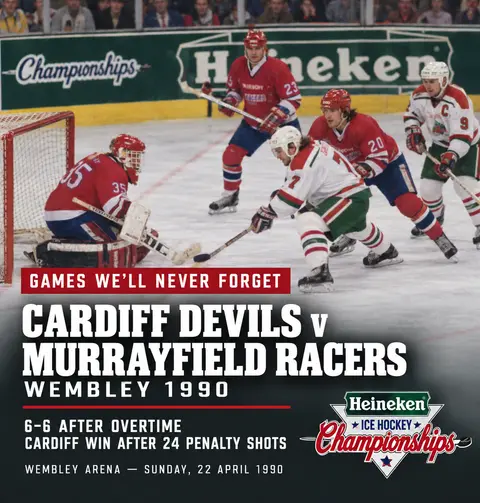
🏒 GAMES WE’LL NEVER FORGET
Cardiff Devils v Murrayfield Racers — Wembley 1990
6–6 after overtime — Cardiff win after 24 penalty shots Wembley Arena — Sunday, 22 April 1990
Some games are remembered because of a great goal.
Some because of a comeback.
Others because of an extraordinary individual performance.
And then there are games like Cardiff Devils v Murrayfield Racers at Wembley in 1990 — games that somehow manage to contain almost everything.
Twelve goals.
A three-goal lead.
A comeback.
A shattered plexiglass panel.
A late equaliser.
Overtime.
Twenty-four penalty shots.
And finally, one save that decided the British Championship.
The contemporary account of the game perhaps described it best:
“No one lucky enough to be at Wembley for this game is ever likely to forget it.”
More than three decades later, it's difficult to argue.
This was one of British ice hockey's great Wembley finals.
🔴 Cardiff — the new kids who weren't supposed to win
To understand what happened at Wembley, you have to understand just how quickly the Cardiff Devils had arrived.
The club had only been formed in 1986.
Four years later, they were walking onto the ice at Wembley Arena as Heineken League Premier Division champions.
And this wasn't supposed to happen.
Cardiff had won promotion into the Premier Division for the 1989–90 season and, according to the contemporary Wembley programme, had begun their first campaign in the top flight as 100–1 outsiders for the league title.
Instead of struggling to survive, they tore through the established order.
Player-manager John Lawless had assembled a team containing a potent mixture of imports and British talent.
There was Steve Moria, Cardiff's captain and offensive superstar.
Doug McEwen, the Canadian forward released by Peterborough who proved to be one of the signings of the season.
Brothers Ian and Stephen Cooper.
Shannon Hope.
And between the pipes, Great Britain international Jeff Smith.
The numbers tell their own story.
Cardiff finished the regular season:
Played 32
Won 28
Drew 1
Lost 3
Goals For 304
Goals Against 146
Points 57
Murrayfield finished second with 49 points. Wikipedia
And then there was Moria.
In just 30 league appearances he recorded an extraordinary 95 goals and 80 assists — 175 points.
McEwen contributed another 118 points, while Ian Cooper passed the century with 101.
Murrayfield had their own superstar, of course.
Tony Hand produced 53 goals and 91 assists for 144 points. Elite Prospects
Cardiff weren't merely surviving their first season among British hockey's elite.
They were setting the pace.
🏆 Murrayfield — Wembley veterans
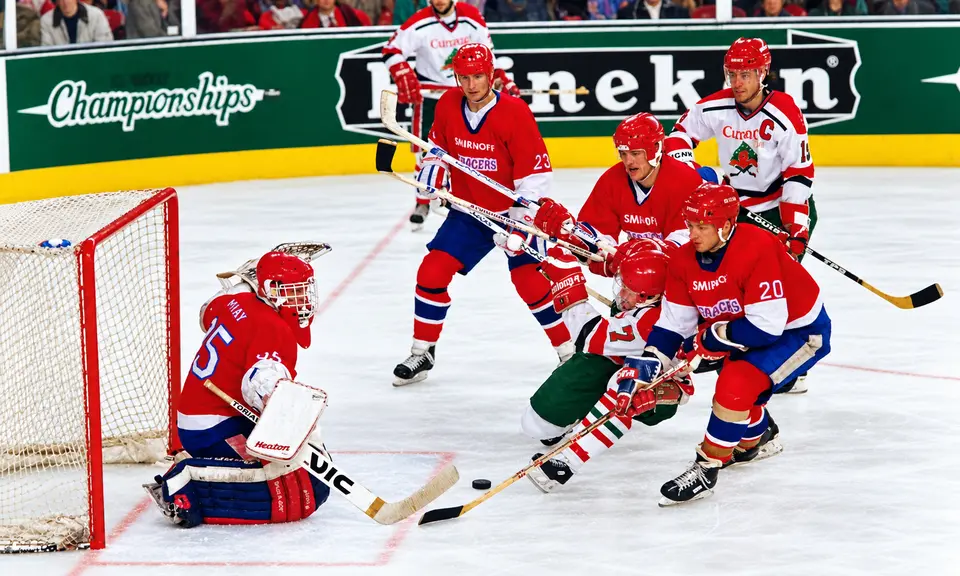
If Cardiff were the new kids on the block, Murrayfield Racers were anything but.
The Edinburgh club had been one of the major powers of British hockey throughout the 1980s.
Their Wembley programme résumé was formidable.
League titles.
Scottish titles.
Cup victories.
Wembley appearances.
And at the centre of it all was arguably the greatest British player of his generation — Tony Hand.
Alongside Hand were players including Scott Neil, Jim Mollard, Brian McKee, Paul Pentland, Chris Kelland, Steve Moore and goaltender Martin McKay.
They had already enjoyed a successful 1989–90 campaign.
The Racers had won the Norwich Union Cup, retained the Scottish League and Cup, and finished runners-up to Cardiff in the Heineken Premier Division.
Now they had another prize in their sights.
For Murrayfield this would be their fifth Wembley final in seven years.
For Cardiff it was their first.
Experience against the newcomers.
Scotland against Wales.
And Wembley was packed for it.
🏟️ Wembley Finals Weekend
For supporters of a certain generation, simply saying “Wembley Weekend” is enough.
Flags hanging from balconies.
Supporters from all over Britain mixing in the concourses.
Club shirts everywhere.
Noise.
Colour.
And three games of hockey packed into one weekend.
The 1990 semi-finals produced:
Cardiff Devils 5–1 Fife Flyers
and
Murrayfield Racers 5–4 Nottingham Panthers
The latter went right to the wire, Jim Mollard scoring a dramatic late winner to send Murrayfield through.
The official attendance across the three Wembley games was 26,176 — just 803 below capacity.
Sunday's final alone attracted 8,935.
And there was another important audience.
The final was broadcast live on BBC Grandstand. Wikipedia
British ice hockey had a national television stage.
What followed couldn't have been scripted much better.
🏒 THE FINAL
Murrayfield explode out of the blocks
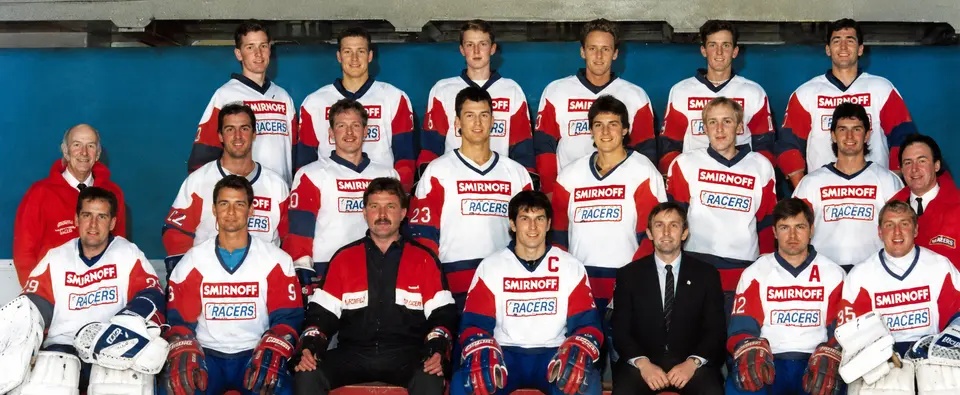
Cardiff may have arrived as league champions, but for the opening 16 minutes they barely knew what had hit them.
Just 27 seconds had disappeared from the clock when Jim Mollard, assisted by Tony Hand and Chris Kelland, put Murrayfield ahead.
0–1.
At 15:22, Hand supplied Scott Neil.
0–2.
Only 47 seconds later, Mollard struck again on the powerplay.
0–3.
Sixteen minutes played.
Cardiff were three down.
For a team appearing in its first Wembley final, this could have become a very long afternoon.
Instead, it became the beginning of the comeback.
🔥 105 seconds that changed everything
At 17:51, Ian Cooper finally found a way through Martin McKay.
Moria and Shannon Hope supplied the assists.
1–3.
Then, with just over a minute remaining in the period, Cardiff struck again.
Doug McEwen scored at 18:45.
2–3.
And Cardiff weren't finished.
With only 24 seconds remaining, Steve Moria made it 3–3.
From three goals down, Cardiff had dragged themselves level before the first intermission.
Three Cardiff goals in 105 seconds.
Wembley had a final.
Murrayfield hit back
After the chaos of the opening period, the second was almost restrained by comparison.
There was just one goal.
At 37:12, Murrayfield's Brian McKee, assisted by Hand and Jock Hay, restored the Racers' advantage.
Cardiff 3–4 Murrayfield.
Twenty minutes remained.
Nobody inside Wembley could have known just how much drama was still to come.
⚡ A third period for the ages
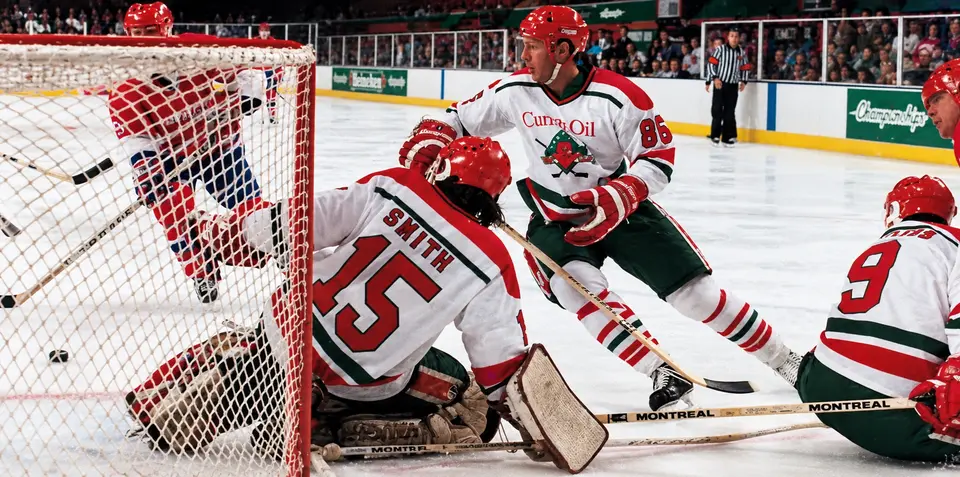
Murrayfield wasted little time extending their advantage.
At 41:57, Scott Neil scored his second of the afternoon.
3–5.
Cardiff were two behind again.
Once more they responded.
At 43:13, Ian Cooper scored his second.
4–5.
Then Tony Hand — the player Cardiff knew they could never afford to lose sight of — struck at 47:58.
4–6.
With just over 12 minutes remaining, Murrayfield had restored their two-goal cushion.
Surely this time the Racers had done enough?
Not quite.
McEwen gives Cardiff hope
At 53:39, Doug McEwen produced another crucial goal, taking a pass from Stephen Cooper.
5–6.
The championship was alive again.
Cardiff pushed.
Murrayfield defended.
The clock continued to disappear.
And then everything stopped.
💥 The plexiglass shatters
Near the end of the third period, a section of plexiglass shattered.
The game couldn't continue.
There was an enforced delay of around ten minutes while the damaged panel was replaced.
For Cardiff, chasing the game and building momentum, it could hardly have come at a worse time.
For Murrayfield, it offered breathing space.
A chance to regroup.
A chance to slow Cardiff's charge.
When play finally resumed, the equation was simple.
Cardiff needed one.
Murrayfield needed to survive.
⏱️ 1 minute 35 seconds
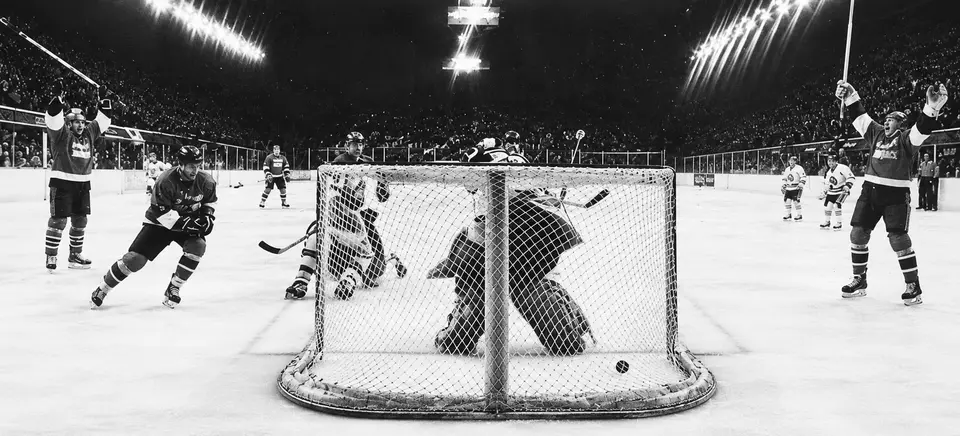
Cardiff kept coming.
With 1:35 remaining, the breakthrough finally arrived.
Stephen Cooper started the move in centre ice and found Steve Moria.
Moria carried the puck into the danger zone before finding Ian Cooper.
Ian spotted his brother continuing his run.
The puck came back across.
Stephen Cooper scored.
6–6.
Wembley erupted.
Cardiff had been 3–0 down.
They had been 5–3 down.
They had been 6–4 down.
Now, with only 95 seconds remaining, they were level.
Even then, the drama wasn't finished.
Jim Mollard nearly stole it for Murrayfield before Jeff Smith produced a vital save.
The clock reached zero.
Cardiff Devils 6
Murrayfield Racers 6
Overtime.
⏱️ Ten minutes of sudden death
There would be one 10-minute sudden-death overtime period.
One goal would end it.
John Lawless was particularly dangerous for Cardiff, but neither team could find the breakthrough.
Ten minutes came and went.
No goals.
No penalties.
Still:
6–6.
There was only one way left to decide the British Championship.
Penalty shots.
🥅 The Wembley shootout
The format began with five shots each.
First five
1. Cardiff — John Lawless: SCORED
2. Murrayfield — Scott Neil: MISSED
3. Cardiff — Doug McEwen: SCORED
4. Murrayfield — Tony Hand: SAVED
5. Cardiff — Steve Moria: SCORED
Cardiff were in command.
But Murrayfield refused to disappear.
6. Murrayfield — Jim Mollard: SCORED
7. Cardiff — Ian Cooper: SAVED
8. Murrayfield — Chris Kelland: SCORED
9. Cardiff — Stephen Cooper: SAVED
10. Murrayfield — Brian McKee: SCORED
After ten attempts:
3–3.
And so began sudden death.
😰 And still they couldn't be separated
John Lawless scored.
Scott Neil answered.
Doug McEwen was stopped.
Tony Hand was stopped.
Steve Moria scored.
Jim Mollard scored.
Ian Cooper was stopped.
Chris Kelland hit the post.
Stephen Cooper was stopped.
Brian McKee missed.
Lawless was stopped.
Neil missed.
Twenty-two penalty shots had been taken.
Still there was no winner.
Imagine being in Wembley at that moment.
Every shot could end the championship.
Every save could prolong it.
And now Doug McEwen stepped onto the ice again.
🚨 PENALTY SHOT NUMBER 23
McEwen skated towards Martin McKay.
The Cardiff forward had already scored twice during the game.
He'd already converted once in the shootout.
Now he had another opportunity.
McEwen scored.
Cardiff had the advantage.
But they hadn't won it yet.
Because Murrayfield still had one shot.
And the man taking it was exactly the player Cardiff would least have wanted to see.
Tony Hand.
🧤 PENALTY SHOT NUMBER 24
Hand against Smith.
One of British hockey's greatest-ever offensive players against Cardiff's Great Britain goaltender.
Score, and the shootout continued.
Miss, and Cardiff were champions.
Hand came in.
He shot.
JEFF SMITH SAVED IT.
That was it.
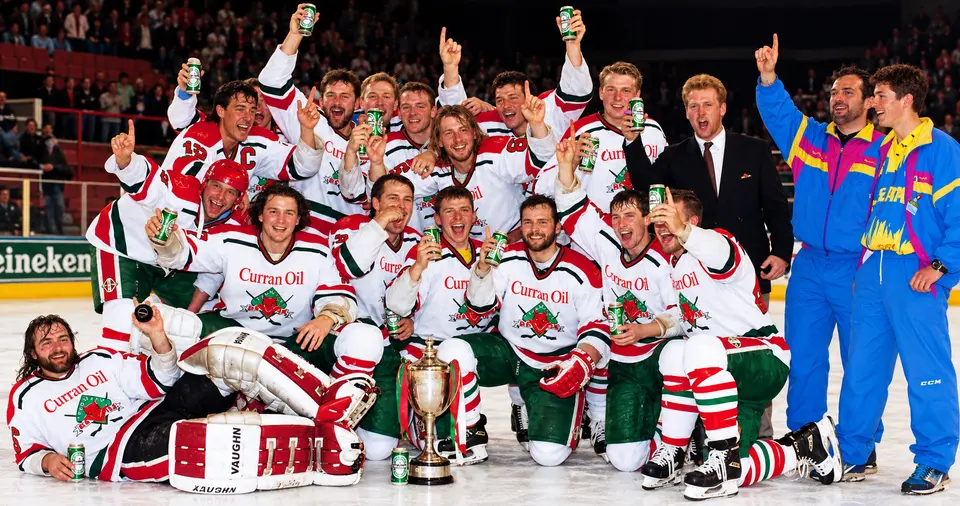
CARDIFF DEVILS WERE BRITISH CHAMPIONS.
The newcomers had completed the League and Championship double in their first season in the Premier Division.
The Cardiff Devils — a club barely four years old — had conquered Wembley.
John Lawless's team had arrived.
The British Ice Hockey Hall of Fame remembers that first Wembley appearance as a dramatic penalty-shootout victory over Murrayfield, the beginning of a period in which Lawless's Devils became one of British hockey's dominant clubs. British Ice Hockey Hall of Fame
🏆 Cardiff Devils — Wembley Champions 1990
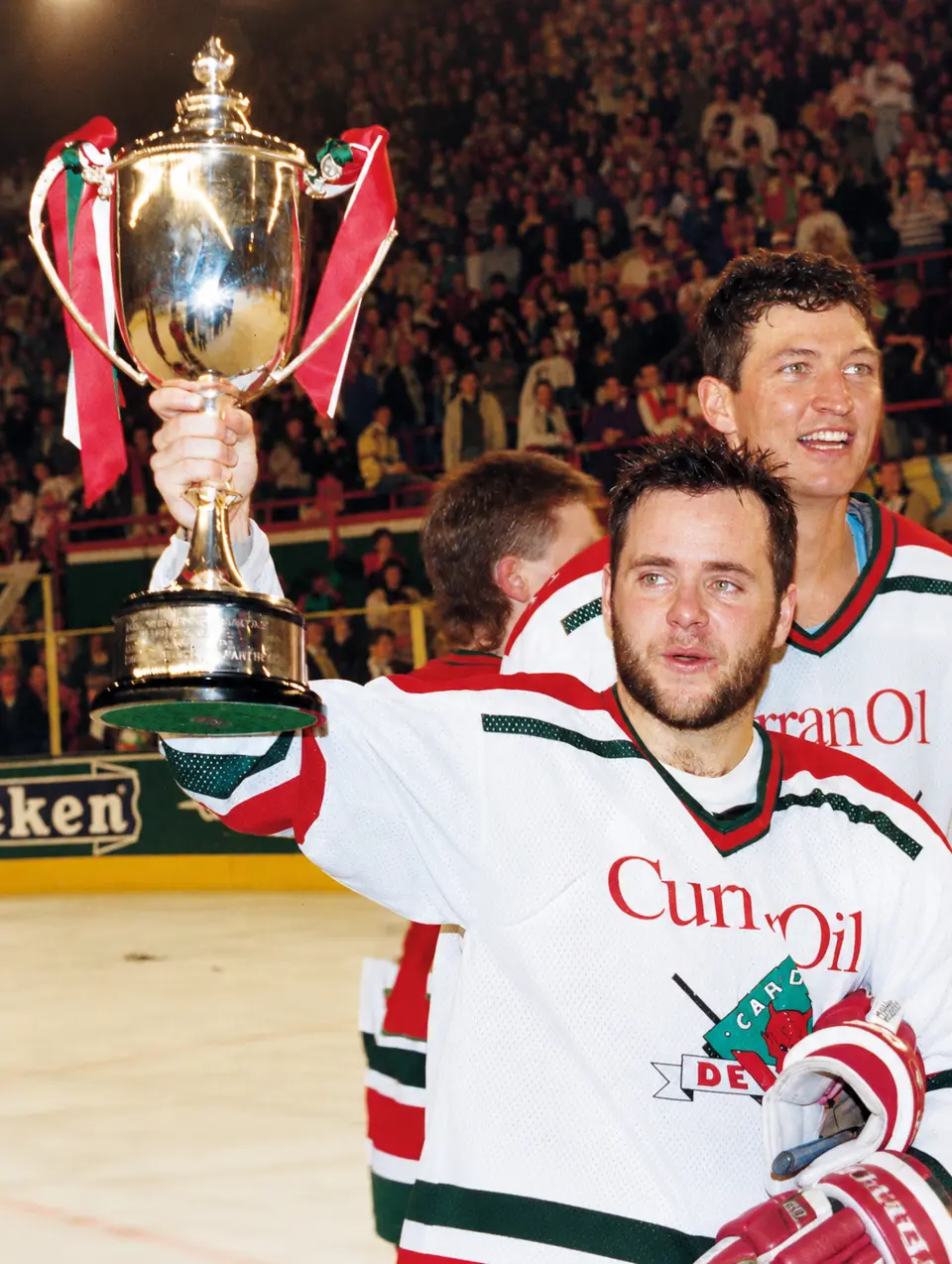
The bare result in the record books doesn't really do the afternoon justice.
Cardiff Devils 6–6 Murrayfield Racers
Cardiff won on penalty shots
But behind those few words lies one of the extraordinary games of the Heineken era.
Cardiff came back from 3–0.
They came back from 5–3.
They came back from 6–4.
They survived the interruption caused by the shattered plexiglass.
Stephen Cooper scored with 95 seconds remaining.
Neither side could score in overtime.
Then came a shootout lasting 24 penalty shots.
McEwen scored number 23.
Smith saved number 24.
And Wembley belonged to Cardiff.
⭐ The numbers behind an extraordinary final
Jeff Smith faced 48 Murrayfield shots during regulation and overtime.
Martin McKay faced 44 from Cardiff.
Then another 24 penalty shots followed.
The final itself attracted 8,935 spectators.
Doug McEwen scored twice during regulation and converted two penalty shots, including the decisive 23rd attempt.
And the championship completed an astonishing first Premier Division season for a Cardiff side that had started the campaign as outsiders and finished it as both League Champions and Wembley Champions.
It was the beginning of something much bigger.
Cardiff would return to Wembley repeatedly during the years that followed. British Ice Hockey Hall of Fame
But there can only ever be one first time.
📺 And Britain watched it happen
There's another reason Wembley 1990 occupies such a special place in British hockey memory.
People didn't only experience it inside Wembley Arena.
They watched it at home.
The BBC carried the final live on Grandstand, taking British ice hockey into homes around the country. Wikipedia
And what a game to show them.
If somebody unfamiliar with British hockey had happened upon the broadcast that Sunday afternoon, they saw almost everything the sport could offer:
Goals.
Comebacks.
Star players.
Noise.
Drama.
Overtime.
And a seemingly endless shootout.
Even the contemporary review of the weekend acknowledged that any complaints about television scheduling were quickly forgotten after the BBC showed the final from face-off right through to Jeff Smith's decisive save.
It was British ice hockey television gold.
❤️ ❤️ Why we'll never forget this one
There are games whose significance only becomes apparent years later.
This wasn't one of them.
Everybody knew immediately that they had witnessed something extraordinary.
For Murrayfield, it was heartbreak.
A team packed with experience and quality had led 3–0, 5–3 and 6–4 and had come within 95 seconds of winning another major trophy.
For Cardiff, it was another remarkable chapter in a story that had barely begun.
Four years earlier, there had effectively been no Cardiff Devils.
Now they were champions of Britain.
And the manner in which they did it somehow fitted the story perfectly.
They didn't win comfortably.
They wouldn't go away.
Three goals down?
Come back.
Two goals down?
Come back.
Two goals down again?
Come back.
Ninety-five seconds from defeat?
Come back.
Twenty-two penalty shots without a winner?
Keep going.
Then McEwen scored.
Smith saved.
And a little piece of British ice hockey history was complete.
Perhaps that's why the line written shortly afterwards still works perfectly today:
“No one lucky enough to be at Wembley for this game is ever likely to forget it.”
They weren't wrong.
🏒 GAMES WE'LL NEVER FORGET
22 April 1990
Wembley Arena
Cardiff Devils 6–6 Murrayfield Racers
Cardiff win 6–5 on penalty shots after 24 attempts
The comeback.
The shattered plexiglass.
Stephen Cooper with 95 seconds remaining.
Ten minutes of overtime.
Twenty-four penalty shots.
Doug McEwen.
Jeff Smith.
Wembley 1990.
A genuine British ice hockey classic.
Were you at Wembley that afternoon — or did you watch it live on Grandstand?
What is the ONE moment from Cardiff v Murrayfield in 1990 that you still remember today?
📺 WATCH IT AGAIN heading. For a story built around “Were you there — or did you watch it on Grandstand?”
Corey Beaulieu – The SuperLeague Defenceman Who Crossed the Sheffield-Nottingham Divide